
Printable ruler
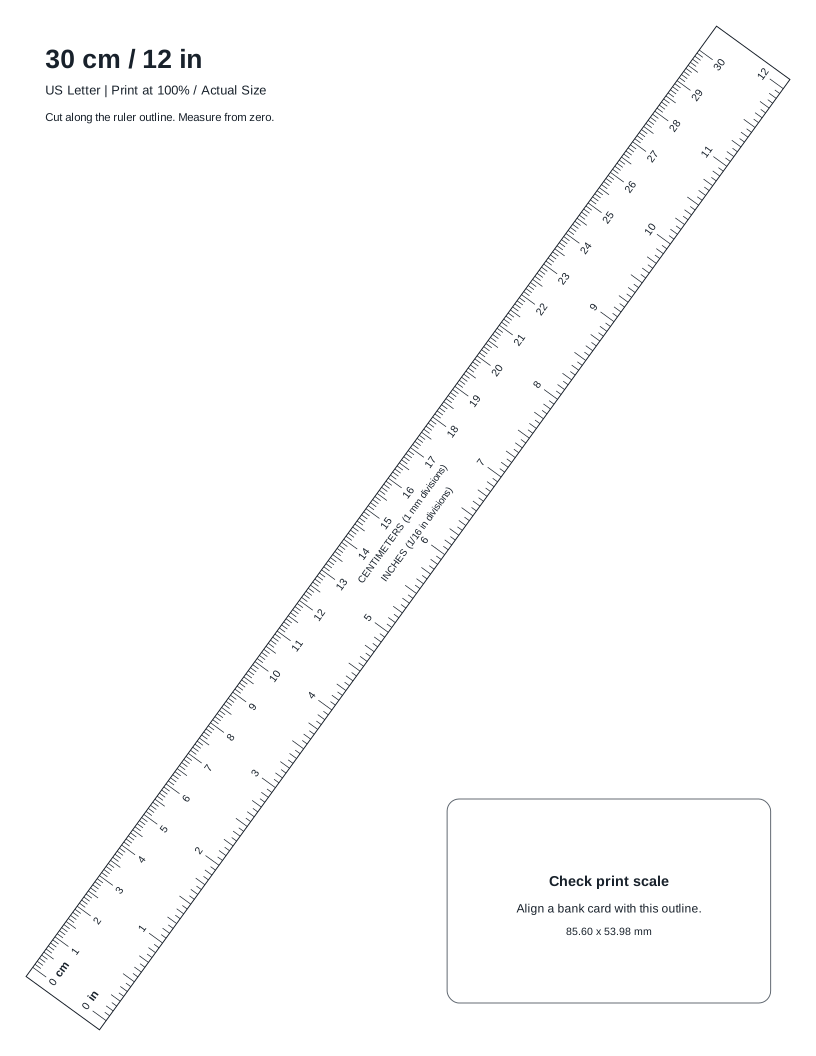
Print and cut out a paper ruler with millimeters on one edge and sixteenths of an inch on the other.
Download PDFPrint at 100% / Actual Size on US Letter paper. Check print accuracy
How to use this ruler paper
-
Print
Load US Letter paper and print the PDF at Actual Size (100%). Turn off “Fit to page.”
-
Cut
Cut along the ruler’s solid outline. Keep the part of the sheet with the bank card outline for the next step.
-
Check
Place a bank card on the printed outline. All four edges should line up. Or line up the zeros on the paper ruler and a physical ruler, then check that their 10 cm marks match.
When to use a printable ruler
Classroom measuring practice
Cut out four short rulers per sheet. Have students measure a pencil from the zero mark, first in centimeters and then in inches.
Check graph paper spacing
After checking the ruler against a bank card, use the centimeter edge to measure ten spaces on a 5 mm grid. They should span 5 cm. Grid spacing guide
Measure a craft pattern
Use the long ruler to mark a 25 cm strip of cardstock or measure a length of ribbon in one pass.
Printable ruler FAQ
How do I know my printed ruler is accurate?
If a standard bank card matches the printed outline on all four sides, the sheet printed at the expected scale in both directions. To check the ruler itself, align its zero mark with zero on a physical ruler. The 10 cm marks should line up too.
What if the card outline prints too small or too large?
Download the PDF for the paper loaded in your printer (A4 or US Letter). Open the PDF, select that same paper size, and choose Actual Size or 100% scale. Turn off Fit to Page, print one copy, and repeat the card check before measuring.
Actual-size printing guideWhich edge do I use for centimeters or inches?
Find the zero marked “cm” for centimeters. Each small division on that edge is 1 mm. For inches, use the edge marked “in”. Each small division there is 1/16 inch.
Do I measure from the cut edge or the zero mark?
Line up one end of the object with the zero mark and read the scale at the other end. The cut end of the paper extends slightly past zero.