
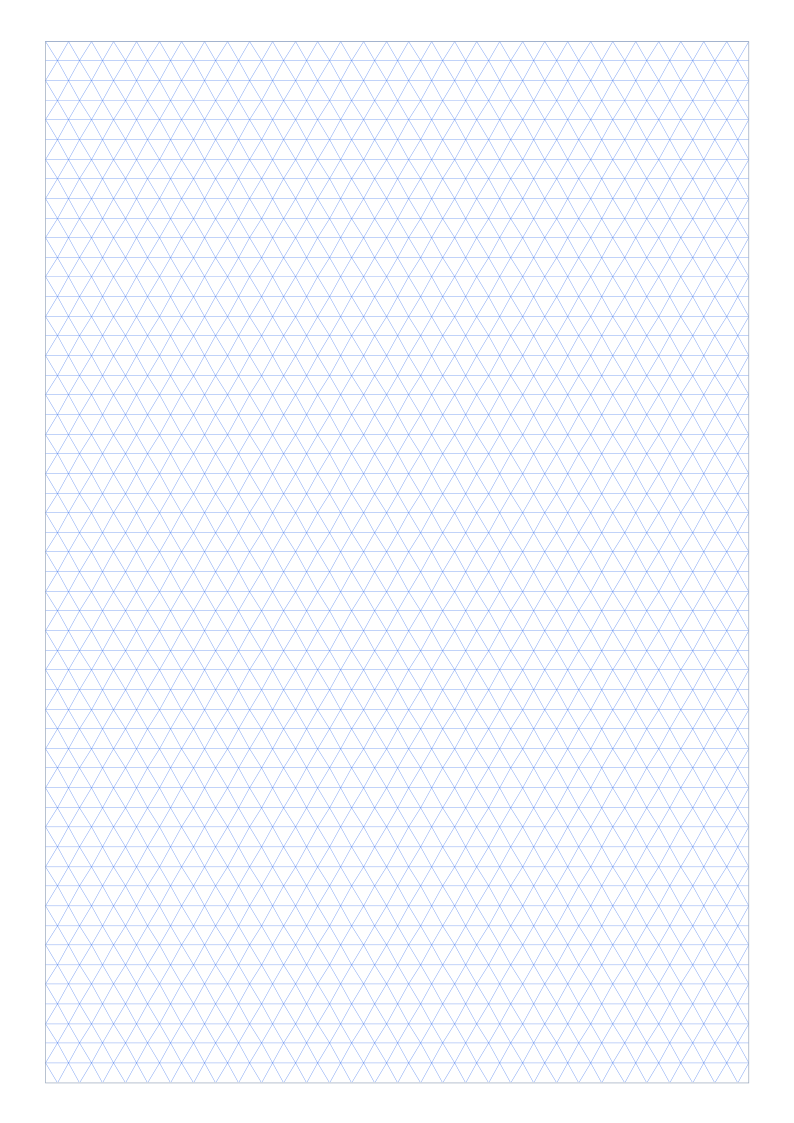
A4 Triangle Grid
Most countries210 x 297 mm (8.27 x 11.69 in)
International home, school, and office printing

Printable Triangle Grid
Choose the triangle side length, grid phase, and page orientation, then download the matching file.
Print at Actual Size or 100% so the prepared measurements stay accurate.
Triangle grid paper uses three sets of evenly spaced lines to form repeating equilateral triangles. The grid provides accurate 60-degree directions and also makes hexagons, diamonds, and repeating geometric forms easy to construct.
Use it for geometry exercises, tessellations, quilting blocks, beadwork, mosaics, technical sketches, and pattern design. Smaller triangles suit detailed constructions, while larger triangles leave more room for coloring, labels, and classroom work.
Check the size printed on your paper pack or shown in the printer tray. A4 is standard in most countries, while US Letter is standard in the United States and Canada. Choose a larger size only when your printer or print service supports it.
210 x 297 mm (8.27 x 11.69 in)
International home, school, and office printing
8.5 x 11 in (215.9 x 279.4 mm)
US home, school, and office printing
297 x 420 mm (11.69 x 16.54 in)
Engineering sketches and larger diagrams
420 x 594 mm (16.54 x 23.39 in)
Large plans, displays, and technical drawings
8.5 x 14 in (215.9 x 355.6 mm)
Long worksheets, calculations, and plans
11 x 17 in (279.4 x 431.8 mm)
Large handouts, plans, and presentation sheets
18 x 24 in (457.2 x 609.6 mm)
Wall charts, maps, displays, and large plans
The choices below explain what changes and when each option is useful. Make the actual selection in the download panel at the top of the page.
A 5mm triangle grid creates a dense field for detailed tessellations, compact geometry, bead patterns, quilting plans, and fine technical sketches.
A 6mm triangle grid balances drawing detail and writing room for general geometry, pattern design, maps, diagrams, and classroom activities.
A 10mm triangle grid provides larger cells for bold constructions, labels, classroom demonstrations, quilting layouts, and designs that need more drawing room.
The choices below explain what changes and when each option is useful. Make the actual selection in the download panel at the top of the page.
The point-up option starts the diagonal line pattern in the phase that places an upward-pointing triangle at the upper grid edge.
The flat-base option shifts the first diagonal row by half a triangle side, changing the phase visible at the upper grid edge.
Construct equilateral triangles, hexagons, 60-degree angles, transformations, and repeating tilings.
Plan quilting blocks, beadwork, mosaics, embroidery, and other designs built from triangular units.
Lay out routes, structures, diagrams, and spatial systems that benefit from three drawing directions.
Choose from 84 ready-made templates. Open a paper-size group, then download the PDF for accurate printing, save a PNG, or customize the same layout in the generator.

A4 portrait · 5mm triangles · Point up

A4 portrait · 5mm triangles · Flat base
A4 portrait · 6mm triangles · Point up

A4 portrait · 6mm triangles · Flat base
A4 portrait · 10mm triangles · Point up
A4 portrait · 10mm triangles · Flat base

A4 landscape · 5mm triangles · Point up

A4 landscape · 5mm triangles · Flat base

A4 landscape · 6mm triangles · Point up

A4 landscape · 6mm triangles · Flat base

A4 landscape · 10mm triangles · Point up

A4 landscape · 10mm triangles · Flat base

Letter portrait · 5mm triangles · Point up

Letter portrait · 5mm triangles · Flat base

Letter portrait · 6mm triangles · Point up

Letter portrait · 6mm triangles · Flat base

Letter portrait · 10mm triangles · Point up

Letter portrait · 10mm triangles · Flat base

Letter landscape · 5mm triangles · Point up

Letter landscape · 5mm triangles · Flat base

Letter landscape · 6mm triangles · Point up

Letter landscape · 6mm triangles · Flat base

Letter landscape · 10mm triangles · Point up

Letter landscape · 10mm triangles · Flat base

A3 portrait · 5mm triangles · Point up

A3 portrait · 5mm triangles · Flat base

A3 portrait · 6mm triangles · Point up

A3 portrait · 6mm triangles · Flat base

A3 portrait · 10mm triangles · Point up

A3 portrait · 10mm triangles · Flat base

A3 landscape · 5mm triangles · Point up

A3 landscape · 5mm triangles · Flat base

A3 landscape · 6mm triangles · Point up

A3 landscape · 6mm triangles · Flat base

A3 landscape · 10mm triangles · Point up

A3 landscape · 10mm triangles · Flat base

A2 portrait · 5mm triangles · Point up

A2 portrait · 5mm triangles · Flat base

A2 portrait · 6mm triangles · Point up

A2 portrait · 6mm triangles · Flat base

A2 portrait · 10mm triangles · Point up

A2 portrait · 10mm triangles · Flat base

A2 landscape · 5mm triangles · Point up

A2 landscape · 5mm triangles · Flat base

A2 landscape · 6mm triangles · Point up

A2 landscape · 6mm triangles · Flat base

A2 landscape · 10mm triangles · Point up

A2 landscape · 10mm triangles · Flat base

Legal portrait · 5mm triangles · Point up

Legal portrait · 5mm triangles · Flat base

Legal portrait · 6mm triangles · Point up

Legal portrait · 6mm triangles · Flat base

Legal portrait · 10mm triangles · Point up

Legal portrait · 10mm triangles · Flat base

Legal landscape · 5mm triangles · Point up

Legal landscape · 5mm triangles · Flat base

Legal landscape · 6mm triangles · Point up

Legal landscape · 6mm triangles · Flat base
Legal landscape · 10mm triangles · Point up
Legal landscape · 10mm triangles · Flat base

Tabloid portrait · 5mm triangles · Point up

Tabloid portrait · 5mm triangles · Flat base

Tabloid portrait · 6mm triangles · Point up

Tabloid portrait · 6mm triangles · Flat base

Tabloid portrait · 10mm triangles · Point up

Tabloid portrait · 10mm triangles · Flat base

Tabloid landscape · 5mm triangles · Point up

Tabloid landscape · 5mm triangles · Flat base

Tabloid landscape · 6mm triangles · Point up

Tabloid landscape · 6mm triangles · Flat base

Tabloid landscape · 10mm triangles · Point up

Tabloid landscape · 10mm triangles · Flat base

Poster portrait · 5mm triangles · Point up

Poster portrait · 5mm triangles · Flat base

Poster portrait · 6mm triangles · Point up

Poster portrait · 6mm triangles · Flat base

Poster portrait · 10mm triangles · Point up

Poster portrait · 10mm triangles · Flat base

Poster landscape · 5mm triangles · Point up

Poster landscape · 5mm triangles · Flat base

Poster landscape · 6mm triangles · Point up

Poster landscape · 6mm triangles · Flat base

Poster landscape · 10mm triangles · Point up

Poster landscape · 10mm triangles · Flat base
Answers about choosing, downloading, customizing, and printing this paper.
The listed size is the side length of each equilateral triangle.
Both options use identical triangle dimensions and line angles. Flat Base shifts the repeating pattern by half a triangle side, changing which part of the grid appears at the upper page edge.
Choose PDF when you want to print at an accurate physical size. Use PNG for notes, worksheets, and image-based documents. Choose SVG when you need an editable vector file for a drawing or design application.
Portrait gives you more vertical working room for worksheets, notes, and tall diagrams. Landscape gives you more horizontal room for charts, maps, tables, timelines, and wide drawings. The prepared measurements stay the same in either orientation when you print at 100%.
The print dialog probably scaled the page. Print the PDF at Actual Size or 100%, and turn off Fit to Page, Shrink, and other automatic scaling options. The paper size selected in the print dialog must also match the file you downloaded.
Yes. Open the triangle grid generator when the ready-made sizes or styles on this page do not match your project.
Open the Triangle Grid Generator →